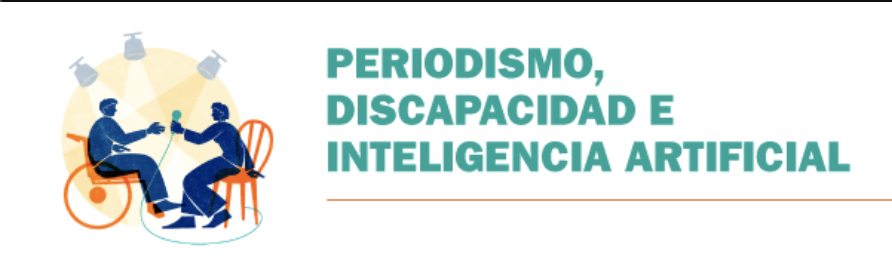
- This Wednesday, the Confederation hosted the conference 'Journalism, Disability, and Artificial Intelligence: The Narrative Inherited by the Machine', co-organized with the Complutense University of Madrid under the slogan "pass the mic, not the stereotype."
- "Nothing about persons with disabilities without persons with disabilities. Artificial intelligence will inherit our narrative, and the question is what narrative we wish to leave behind," warns COCEMFE President Anxo Queiruga.
- The conference emphasized how biases and stereotypes regarding disability in the media can be reproduced and amplified through artificial intelligence, and what journalism can do to contribute to a more rigorous and inclusive narrative.
(Madrid, October 1, 2026)
The Spanish Confederation of Persons with Physical and Organic Disabilities (COCEMFE) hosted this Wednesday the conference 'Journalism, Disability, and Artificial Intelligence: The Narrative Inherited by the Machine', co-organized with the Faculty of Information Sciences at the Complutense University of Madrid (UCM), under the slogan "pass the mic, not the stereotype" and hosted by journalist, presenter, and university lecturer Laila Jiménez.
During the opening remarks, COCEMFE President Anxo Queiruga stressed that "if we feed artificial intelligence (AI) a biased narrative, we cannot be surprised when we obtain a biased outcome," stating that "disability has been underrepresented in the media and, when it has appeared, it has all too often been framed through paternalistic perspectives, focused on limitations, or, at the opposite extreme, through overcoming-the-odds narratives that turn everyday situations into extraordinary feats."
"The machine will inherit our narrative. The question is what narrative we wish to leave behind," Queiruga continued, advocating for "a narrative in which persons with physical and organic disabilities are represented through reality, diversity, and rights. A narrative built with our participation and not solely about us."
For her part, Laura Sánchez Beltrán, Head of Service at the General Subdirectorate of Civil Dialogue, argued that "the way society talks about disability directly influences the way that society treats persons with disabilities," and therefore, "this conference is not only about media and technology, but fundamentally about human rights."
In this regard, Ángel L. Rubio Moraga, Dean of the Faculty of Information Sciences at UCM, underscored the importance of "choosing an image, deciding who appears in a news story and who is left out, and choosing one word over another," to which "an additional responsibility must be added, as all of this matters because it also generates data that educates and trains machines." "The quality of journalism no longer merely shapes the information society receives today; it can also shape the information that technological systems will provide in the future," he added.
During the first session of the conference, José Antonio Solves, professor and researcher at CEU Cardenal Herrera University, provided "a brief overview of research in disability and communication over the last 40 years." "We have improved, we are less paternalistic, but tendencies remain to exclude the voices of persons with disabilities, rely solely on official sources, and perpetuate stereotypes," indicated Solves, who also stressed the need to "investigate not only content and discourse, but also the societal impacts of media narratives."
Next, Adrián Moreno, researcher and lecturer specializing in cyber intelligence and digital communication, explained that "algorithms tend to replicate biases and, if left uncorrected, human beings also tend to replicate these biases—whether in the media or in any aspect of life—simultaneously feeding artificial intelligence with these biases that grow increasingly amplified, creating an endless vicious cycle." Therefore, he asserted that "there must be continuous human oversight. Human beings must remain at the center of all artificial intelligence systems, rather than simply accepting what AI produces as our primary source of data and information."
Finally, the panel discussion entitled "Solutions: Responsible Journalism on Disability" was held, moderated by Laila Jiménez, bringing together practicing media professionals with and without disabilities: David Martínez Menayo, Chief Economics Editor at Servimedia; Merche Borja Gómez, editor at Capaces (20 Minutos); Guillermo Infantes Capdevila, disinformation journalist on the fact-checking team at Newtral.es; Belén Remacha, journalist at El País; and Manuel Martínez, journalist at RNE.
"Instances of inappropriate terminology still occur, but they are becoming less frequent," stated Martínez Menayo, who advocated for the use of the term "persons with disabilities" and emphasized that "it is harmful to use derogatory terms, but it is also detrimental to go to the opposite extreme and resort to excessive euphemisms that end up overshadowing or rendering invisible the reality of disability, such as the terms 'functional diversity' or 'differently abled.'"
Likewise, Borja Gómez criticized the fact that "it still happens that certain words are used pejoratively, for instance saying 'this person is autistic,' which is deeply frustrating," yet she welcomed that, within journalism, "I have always found people willing to change their headlines if they have used inappropriate terminology."
In this context, Infantes Capdevila explained that "narratives or content affecting the representation of persons with disabilities stem more from poor professional practice than deliberate disinformation," which he stated is due to the fact that "disability is highly diverse."
Remacha emphasized the importance of "reading and listening" to understand how to report properly on persons with disabilities. "We must amplify the voices of those who have expertise, those who have been working in this field for a long time, and persons with disabilities themselves," she concluded.
Regarding artificial intelligence, Martínez, for his part, insisted that "AI is repetitive, recognizes patterns, and summarizes data," meaning that "if we have been feeding it data with a specific bias for 20 years, AI will simply replicate it."
This conference, which was concluded by the Director of COCEMFE, Elena Antelo, is funded through the grants for general interest activities of social value under the 0.7% tax allocation call of the Ministry of Social Rights, Consumer Affairs and Agenda 2030.
Download documentation:
The Spanish Confederation of Persons with Physical and Organic Disabilities (COCEMFE) is a non-profit NGO founded in 1980. Its mission is to achieve an inclusive society that ensures the full exercise of human rights for persons with physical and organic disabilities. It coordinates, represents, and strengthens the Associative Movement of persons with physical and organic disabilities in Spain, comprising 94 state, regional, and provincial entities, which in turn represent more than 2.6 million persons with disabilities and bring together over 1,600 associations.